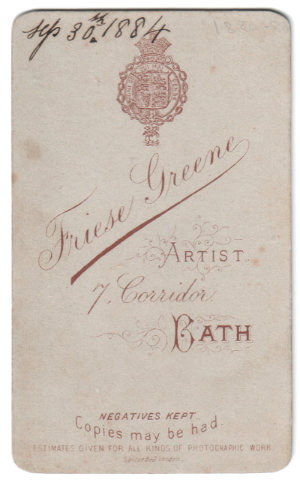
(Click or tap image for back)
CdV sized portrait of a Great Western Railway worker, taken at Friese-Greene’s studio in Bath (at 7 Corridor). There is no name on the back, but there is a hand written date of 30th September, 1884.
The carte de visite, abbreviated CdV, was a type of small photograph which was patented in Paris by photographer André Adolphe Eugène Disdéri in 1854, although first used by Louis Dodero. Each photograph was the size of a visiting card, and such photograph cards were commonly traded among friends and visitors in the 1860s. Albums for the collection and display of cards became a common fixture in Victorian parlours. The immense popularity of these card photographs led to the publication and collection of photographs of prominent persons. The size of a carte de visite is 54mm (2.125in) × 89mm (3.5in) mounted on a card sized 64mm (2.5in) × 100mm (4in). (Wikipedia)
If you have heard of William Friese-Greene, it may be in connection with the history of the cinema. William was a pioneer and inventor in that field, and much has been written about him recently because 5th May, 2021 marked the centenary of his death.
Here I am going to concentrate purely on Friese-Greene’s early years as a studio photographer. It is difficult to find many examples of his photography work online, so I hope that this website will prove useful to other researchers. If you can add any further information about the photographs, please contact me.

William Friese-Greene in 1889. Photograph from the book “Friese-Greene, Close-up of an Inventor” by Ray Allister. Marsland Publications, London, 1948
1855 (September 7th) Born William Edward Green
1871 (aged 15) Apprenticed to Marcus Guttenberg (Polish born photographer) in Bristol for a fee of £10
1874 (aged 18) (24th March) Married Victoria Mariana Helena Friese at St George’s Church, Brandon Hill, Bristol, and changed his name to include hers
1874 Following a disagreement with Marcus Guttenberg, he ended his apprenticeship early
1876 (aged 21) Set up his first studio at 3 Old Bond Street, Bath
1878 (aged 23) Moved to 7 The Corridor, Bath. Took photographs by electric light, very rare at the time
1879 (aged 24) Opened studio at 155 Union Street, Plymouth
1881 (aged 26) Opened ‘The Photographic Institute’ in Queens Road, Bristol and a second Bath studio/gallery at 34 Gay Street
1885 Opened his first London studio at 69 New Bond Street
1887/8 Looking for a business partner, William Friese-Greene found two brothers Arthur Esmé Collings and James White Collings. The Collings brothers partnered with William at his premises at 69 New Bond Street, which consisted of two rooms above a shoe shop. Later they opened another studio in Piccadilly, at number 92, facing Green Park, it was to have an underground studio, and all the photographs were to be taken by electric light. They opened another London studio at 100 Westbourne Grove, and one at 69 Western Road, Brighton (now in Hove)
1888 Esmé Collings had been in partnership with the more famous William Friese-Greene but dissolved the business in 1888 because of Friese-Greene’s unreliability and tendency to spend time and money on an endless stream of projects, foremost among them being the pursuit of moving pictures. At dissolution of the partnership, studios were allocated among the three men, Esmé taking 69 Western Road and New Bond Street. As David Fisher states*, Western Road was renumbered to 120 in 1893, and Collings seems to have occupied it continuously until the First World War. (*Cinema-by-Sea, film and cinema in Brighton & Hove since 1896 by David Fisher – ISBN 978-0-9574449-0-4)