Wiles Postcards
This is a book of two parts. In the first part, I am illustrating some of the best cards from my collection, produced early in the 20th Century, most of which were photographed in Sussex. Whenever I am able to, I have included some information about the photograph that is shown, or perhaps a small enlargement to show a particular detail.
The second part is a catalogue which I hope will act as an aid to dating any similar cards that you may have in your own collection.
I have also included a section which shows 68 different postcard backs, cross-referenced to their postcard fronts, as this too can aid with dating any cards which don’t have the date of an event, or a date of posting. The catalogue includes a small illustration of each card, many of which I do not own, but have found on the Internet, usually included on auction websites such as eBay. Often this means that I have not seen the back of the card, so I am unable to reference it.
The time period that this book covers was big for postcards. They were the emails, or text messages of their day, and the postal service was excellent, so that a postcard was normally received very quickly. People collected all kinds of postcards, some as souvenirs of events that they attended, some of places they visited, and others with famous people or a view that they liked, as a means of sending a quick message to a friend. In fact postcards were so popular that in many towns there were postcard shops where you could choose from many hundreds of real photograph cards, as well as screened and printed versions.
My Wiles postcard collection numbers over 300 cards produced by the various photographic studios and individuals that were linked together at one time or another. These include Thomas Wiles and his brother George, the partnership Deane, Wiles and Millar, and the Brighton Camera Exchange. The cards date from my earliest photographic example, showing the beach at Hove, posted in July 1909, up to the most recent which has the Sussex County Cricket team of 1936.
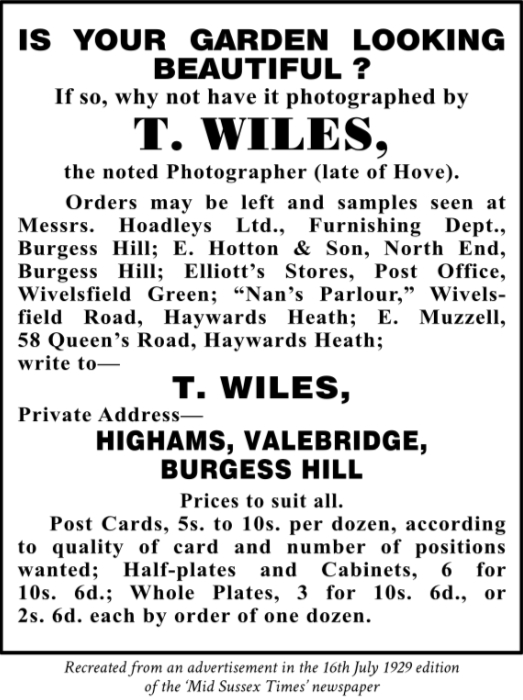
Thomas Wiles is my particular favourite. He had his own shop in Hove, East Sussex, in which he sold his postcards. In later life, he moved to my home town of Burgess Hill, West Sussex, and took many local views which were sold in various shops around the town in the 1930s.
This book and catalogue presents just a small sample of the many postcards that were produced by the Wiles brothers. Some of the real photo cards are now approaching 120 years old, and are beginning to show their age. Work has been needed to improve the image quality enough to include them here, especially the oldest cards as they have faded dramatically. However, with the help of Affinity Photo on my trusty computer, I have managed to recover these fascinating pieces of history.
How I long to be able to step into a time machine and visit Brighton in 1924, then park my car on the seafront, and explore the famous West Pier (my favourite of Brighton’s two piers) which is now sadly just a ruined metal shell. Or perhaps I could buy a flat cap, then go back a little further, to 2nd March 1912, and join the crowd to watch Brighton and Hove Albion beat Watford by 7 goals to 1.
My maternal Grandad played for England schoolboys. He was a lifelong football fan, and a supporter of Tottenham for whom he could have played (the wages were too low back then so he went into the paint trade instead!). In his youth, during the school holidays, he stayed with an aunt near Brighton. She was a cook at Roedean school for girls.
He later bought a house in Saltdean. I often wonder, when looking at the faces in the many crowd photos taken at Brighton football matches, if I am going to see him there smiling back at me. The time period covered by these postcards was also much of his prime time, from the age of 18 to 45. I feel that this book is also a snapshot of part of his life.
Coming Soon | David Ransom